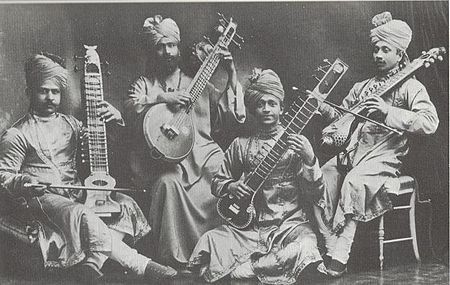
The Royal Musicians of Hindustan circa 1910
There are two main schools of Indian classical music: the Hindustani style of the North and the Karnatak (also spelled Karnatak and Caranatic) of the South. The Hindustani style features a number of Turk-Persian musical elements not found in the more varied and, in some ways, complex Karnatak style.
A gharana (literally meaning “extended family”) is a school of music. Certain ones have good reputations. They are more like philosophical schools than formal institutions. There are ones for singing and various instruments and they often distinguished by style and mode of thought. They have usually been founded by famous singers or musicians.
Traditionally musical traditions have been passed on orally and musical skills have often been taught from father to son or teacher to pupil. Students pay respect to their instructors by touching their feet. The relationship between teachers (known as pandits and gurus in Hindi and ustaad among Urdu) and their pupils is very important in Indian music. Teachers and pupils are often related, and the spiritual element of the instrument is often as important as technical virtuosity. In northern India, the spiritual relationship is symbolized by a ceremony in which a teachers ties a string around the wrist of a pupil.
Some styles of Indian music are associated with a specific faith. Bhajans and kirtis, for example, to Hinduism and qawali is a form rooted in Sufi Islam. As a rule Hindu styles are performed by Hindu performers and Islamic styles are performed by Muslim performers.

 musings of a music nerd/fan
Worth Reading 👌✨
LikeLike
It’s awesome, good work.
LikeLike